What is Ai Logistics Agents
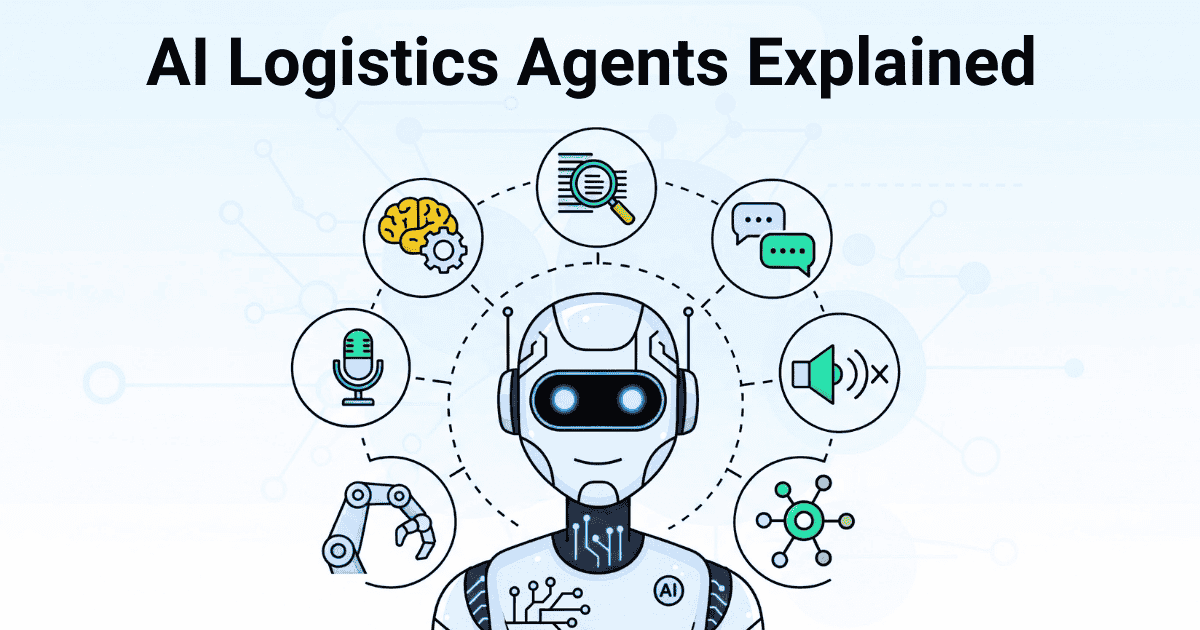
Logistics has always been messy. Not necessarily because teams don't plan, but because real life keeps getting in the way. Conditions change faster than people can reasonably keep track of them. That's where AI logistics agents come into the picture.
For the most part, traditional logistics software focuses on visibility. They showed teams what was happening, but they still left humans to connect the dots and decide what to do next. Think dashboards and reports.
AI logistics agents are not dashboards or reports. Instead, they thrive in the gap between noticing a problem and acting on it in real-time.
For AI logistics agents to work properly, they should not replace people. These systems are designed to notice changes and recommend a course of action, but humans should still be at the helm of the ship, so to speak.
This is vital for logistics in 2026, because teams simply cannot babysit every decision anymore.
Industry research shows that logistics companies deploying AI agents in 2025-2026 are reporting 30-40% reductions in manual coordination tasks and up to 25% faster response times to operational disruptions. These numbers continue to climb as the technology matures and teams grow more confident in agent-assisted decision-making.
What are AI logistics agents?
Now that we've established what they're not, let's look at what they really are.
The easiest way to explain it is this: AI logistics agents are software-based systems that observe conditions in real-time and decide what to do. Depending on the parameters set, they can also act on those decisions.
They can work non-stop around the clock to monitor data from orders, vehicles, fleet management systems, warehouse operations, traffic, customer interactions, etc.
But instead of waiting for instructions like a human would need to, AI logistics agents operate within defined boundaries (parameters) and then respond accordingly.
What AI agents mean for logistics
Think of an AI agent as an employee that never stops, and has the ability to monitor vast amounts of live and historical data, across your entire business, in a matter of seconds.
This includes delivery progress, delays, capacity constraints, stock inventory, shipping, customer signals and more.
In most cases, their role is to maintain awareness without requiring constant human input.
AI logistics agents make decisions
They are not bound by single rules. So instead of following instructions one at a time, they evaluate context based on all data collected.
They look at what has happened before and what is happening now, and they note any constraints that may apply.
Then, based on that analysis, they predict the most appropriate action for the situation (ie, what happens next).
How AI agents take action
Once a decision is made, an AI agent can trigger updates or changes across systems.
This might involve adjusting schedules or updating ETAs. Based on their parameters, it could even include reassigning tasks.
And it can do all that without manual intervention.
How AI logistics agents differ from automation
AI logistics agents differ vastly from traditional automated logistics.
Traditional automation runs on fixed rules. The system notices a specific, established trigger and executes a predefined response.
This works perfectly well in stable environments, but logistics is rarely stable.
So AI logistics agents are designed to adapt when plans fall apart, even when situations don't match a predefined rule programmed into the system.
They respond to context as a whole, rather than single events, which makes them better suited to what actually happens in real life.
Rules-based systems vs context-aware agents
There are two broad approaches to agents: rules-based and context-aware.
1. Rules-based systems
Rules-based systems react to individual conditions. A specific trigger happens and the system performs a predefined action.
For example, the trigger could be a delivery marked as "missed" or "attempted delivery". The system notes it and automatically sends a predefined email to the customer.
Then it goes one step further and reschedules the delivery for the next available slot. That works when situations are predictable and nothing unexpected gets in the way.
This is also why humans still need to be in charge, because the AI agent does not ask why the delivery was missed or whether rescheduling is the best option. It just executes the rule it was given.
If it's the right move, it saves the human employee time and possible human error. If it was wrong, there's a human pair of eyes looking at it that will understand context.
2. Context-aware agents
These agents work differently.
Instead of reacting to one signal at a time, they look at several factors together and connect the dots of how those factors relate to each other.
Traffic, capacity, timing, priorities, downstream impact, whatever the condition may be, it all gets considered before a decision is made.
Example: A late driver is not just a late driver. It can affect warehouse staffing and the next set of deliveries.
So a context-aware agent can recognize those knock-on effects and adjust decisions based on the bigger picture, not just the first issue it detects.
Where rules-based systems follow instructions, context-aware agents evaluate situations.
What AI logistics agents actually do
In daily operations, AI logistics agents focus on keeping workflows moving smoothly. They reduce manual coordination and help prevent small issues from becoming way bigger headaches.
They step in before problems escalate. They do this by:
1. Monitoring real-time signals
Some of the signals they track could include:
- Deliveries
- Vehicle activity
- Stock inventory
- Warehouse activity
- Live customer comms
These data points give logistics teams a clearer picture of what is actually happening across the operation.
2. Responding to change as it happens
When any of those conditions change, the AI agent can adjust plans automatically (obviously within its approved limits and configured parameters).
As a result, you have less delays to deal with, and your human team is able to respond faster without constant monitoring of the system, and constant intervention.
3. Reducing reactive work
AI agents can also reduce reactive work by handling routine adjustments, and also the amount of problem-solving required from human teams.
Who wouldn't want calmer, more predictable operations?
Common types of AI logistics agents
Most logistics environments use multiple agents, each with a specific focus. These agents work together as a team, not in isolation.
1. Dispatch and scheduling agents
These AI agents assign tasks and make changes to the scheduling as the need arises. As discussed, they do this efficiently without constant manual oversight.
Tasks are distributed much more evenly this way.
2. Route and ETA adjustment agents
Route-focused agents update routes and delivery estimates when disruptions occur, like traffic delays, severe weather conditions, vehicle breakdowns, late runs, etc.
The time you save by not having to do manual rerouting is worth the investment. For more on how route optimization technology works, see our guide on route optimization: how it works and why it is essential.
3. Exception and disruption agents
When something severely veers off course from the original plan, these agents identify the issue and highlight potential downstream impacts.
So now your team can respond while there is still time to adjust!
4. Customer communication agents
These agents handle updates and notifications, such as sending customers accurate information about their deliveries or any changes that occurred.
Fewer "where's my order?!" calls for you to deal with!
Human-in-the-loop vs autonomous agents
Most real-world logistics systems sit between full manual control and full autonomy.
This balance is intentional. Lean too far toward manual control and human error creeps in. Lean too far toward full autonomy, and you lose control when an AI agent makes a mistake.
Human-in-the-loop approaches keep people involved where it really matters (the final decisions), while agents handle routine tasks.
1. Where humans stay involved
Humans should:
- Approve exceptions
- Override decisions
- Provide judgement in unusual scenarios
This is how you keep the trust you've built with your customers while simultaneously reducing risk.
2. Where autonomy makes sense
AI agents should:
- Handle repetitive tasks
- Handle time-sensitive decisions that follow clear constraints
Now your human team is free to focus on strategic work rather than micromanagement and soul-destroying admin tasks.
Benefits of using AI logistics agents
We've looked at quite a few benefits already: faster decision making, efficient rescheduling, etc. But the biggest benefit of AI logistics agents is probably their ability to scale.
As operations grow, so does the volume of decisions.
This is how it works:
1. Faster decision-making at scale
We've mentioned that these agents work continuously, which makes decisions happen faster than manual processes.
There is no delay, since the AI can make those decisions faster than a human can (provided it's trained on the correct set of data).
2. Reduced manual coordination
By handling routine changes, agents reduce the need for constant communication between teams (and with customers).
Your customers now receive their updates faster, your support team is not bogged down by unnecessary comms admin. And they can devote their time to more serious customer disputes.
3. Better handling of disruptions
Early detection and response minimize the impact of unexpected events.
Since AI systems can connect the dots of what might happen downstream, they can make decisions that prevent negative outcomes.
Challenges and limitations of AI logistics agents
Despite their benefits, we'd be amiss not to mention that AI logistics agents come with challenges organisations must address.
1. Data quality and reliability
Agents depend on accurate and consistent data. Poor data will only curb how effective they can really be.
You don't want to input data that is outdated, fragmented, or wrong, because then even the most advanced agent will make weak decisions.
2. Integration complexity
Agents require access to multiple systems and historical data (plus live data) to understand context. This level of integration can be time-consuming.
But it is critical! Without clean connections between platforms, agents won't have enough visibility to make decisions confidently.
3. Trust and adoption
Teams need to understand how agents work, so you will have to invest in training.
Apart from training, transparency is equally important to maintain trust.
People might be hesitant of AI, but when they know why an agent made a decision, they're far more likely to use it correctly.
The role of AI logistics agents today
In 2026, logistics complexity has made manual decision-making increasingly unrealistic and very time-consuming.
AI logistics agents are the practical choice because they act as coordination systems that help people and platforms work together in real time.
1. From insights to action
From 2023 to 2025, organisations simply relied on AI-powered insights. But businesses are now moving toward AI systems that can act, not just report.
Reports and dashboards are cool, but instead of waiting for a human to interpret the data, just let agents analyze it and handle the "getting-things-done" part. For a broader view of how AI is being applied across the logistics sector, see our companion article on AI logistics explained.
2. Supporting teams under pressure
Agents reduce cognitive load so your teams can stay focused under pressure, especially when conditions change.
This gives people breathing room to handle exceptions and judgment calls, instead of constantly putting out figurative fires.
3. How AI agents work together
Most operations rely on multiple agents working in parallel, not in isolation.
By having different agents (1) focus on specific tasks, and then (2) work together as a team, they can reduce delays and bottlenecks.
So basically each agent focuses on a specific responsibility while sharing context with the others, so they can make informed decisions across the board.
Which brings us to...
4. Coordinating decisions across functions
AI agents share information and align across all the different aspects of your operations. From routing through to dispatch and warehousing, even communication.
So you won't have a situation where one decision creates a problem somewhere else! The AI agents already spotted the connections.
5. Scaling without fragmentation
When a logistics operation grows, teams often add more tools, more dashboards, more staff. This usually translates into higher costs and more maintenance.
This is how silos are created and breakdowns happen.
What you want is growth that doesn't force the business to split into separate, disconnected systems. You want agents that stay connected and coordinate decisions across the whole operation.
AI logistics agents vs AI route optimization
The two are vastly different.
While AI route optimization calculates routes, AI logistics agents decide when and how to apply those calculations.
Think of AI-powered route optimization to give you the answer, and AI agents to decide what to do with them.
A route plan generated by AI-powered route optimization might be technically optimal, but an agent can choose not to apply it if a driver is already overloaded.
TL;DR
AI logistics agents monitor operations and make decisions in real-time, faster than humans. They can also take action inside logistics systems, based on their configuration.
They sit between data and execution, coordinating responses across tools and teams.
In 2026, they help teams manage complexity and respond faster to changes as they occur. And they help your business scale without losing human control.
2026 Key Takeaway
According to logistics benchmarks, adoption of AI agents in logistics operations grew by over 45% between 2024 and 2026, with the strongest uptake among mid-size operators managing 20-200 vehicles. The businesses seeing the greatest returns are those that start with clearly defined agent parameters and expand autonomy gradually as confidence builds. If you are considering AI agents for your logistics operation, the recommendation is clear: start small, measure results, and scale from there. Pairing AI agents with a robust delivery management platform ensures the agents have the data foundation they need to make reliable decisions.
Related Articles
Scaling Delivery Operations With Business Growth in Melbourne
Melbourne's logistics sector is experiencing significant expansion, with approximately 30,000 courier companies nationwide maintaining a consistent 5% annual growth rate. True scalability relies on leveraging AI-driven route optimisation and immediate data to manage increasing order volumes...
Managing Mixed Delivery Fleets Across Australian Operations
Running a diverse fleet across Australian operations is not a simple matter. Whether you're coordinating tractors and harvesters on a farm, managing utes and transport trucks for construction, or overseeing specialised equipment across multiple sites, the complexity can quickly become overwhelming...
Warehouse Management
In the fast-moving world of logistics and supply chain management, warehouse management has emerged as a defining factor for operational success....